
I got a knock on my door once from a guy offering ductwork cleaning for $99. Whole house, same day. Sounded great until I asked what it actually covered. Turned out to be three vents and a smile. That $99 flyer price is basically the industry’s favorite bait. Taught me more about this business than any article I’d read before it. This guide covers the six real signs your ductwork actually needs cleaning, the four signs you’re being sold something you don’t need, and what a legitimate job actually costs versus a scam quote dressed up as one.
What Does Ductwork Cleaning Actually Involve?
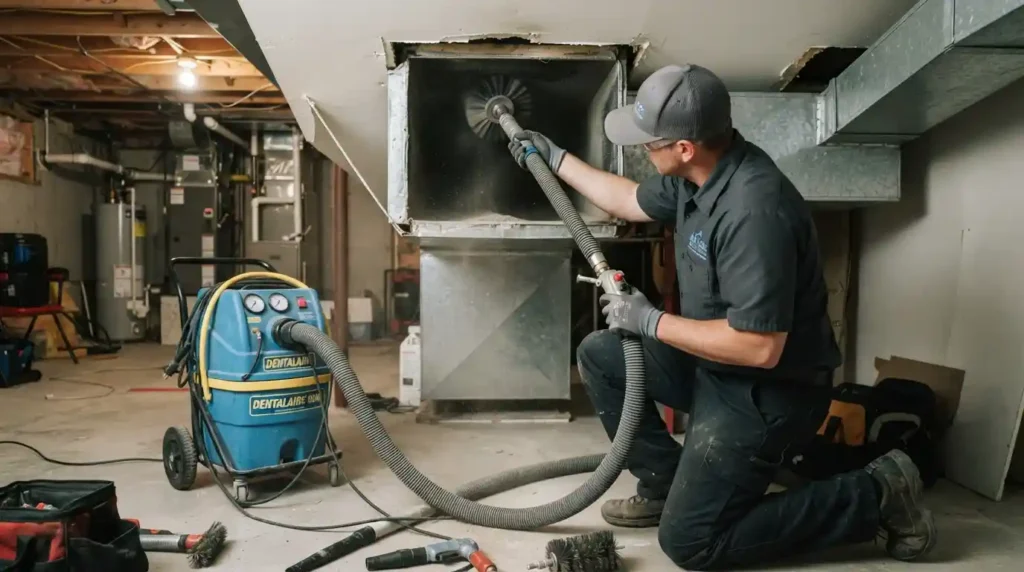
A real job covers the whole system. Not just a handful of visible vents with a vacuum stuck in for thirty seconds. Supply ducts. Return ducts. The main trunk lines. The blower compartment. Often the evaporator coil and drain pan too. NADCA’s source-removal method pulls debris out through a single point using negative pressure. Rotary brushes or air whips agitate the stuck-on dust first, then it all gets vacuumed away.
I watched a technician do this on my own system a couple years back. Negative-air machine humming the whole time, keeping dust from blowing back into the house while brushes worked loose years of buildup inside the metal. Genuinely satisfying, honestly. Years of dust disappearing into a hose instead of settling right back onto every surface in my living room.
What’s the difference between duct cleaning and ductwork cleaning?
There isn’t one, really. The terms get used interchangeably across the industry. Both mean cleaning the full network of supply and return ducts, plus connected components like the blower and coil, not just wiping down a few visible vent covers.
6 Real Signs You Need Ductwork Cleaning
I’ve dealt with a few of these directly. My own place, or helping a neighbor sort out a genuine problem from a sales pitch.
1. Visible mold inside the ducts or on the coil
Clearest, least debatable sign there is. Confirm it visually or through testing. Not just a stranger’s flashlight and a confident voice pointing at what’s actually just normal dust.
2. Recent water damage or flooding near the ductwork
Wet insulation or standing water near ducts needs attention fast. Within 24 to 48 hours, ideally, before mold gets a real foothold. Fiberglass-lined ducts that got soaked usually need full replacement, not just a good drying out.
3. A persistent musty smell when the system runs
Smell shows up specifically when the heat or AC kicks on? Often points to moisture or mold somewhere inside the system. Not just a stuffy room that needs a window opened.
4. Visible rodent or insect activity in the ducts
Droppings, nesting material, actual pests visible through a vent. Means the ducts need cleaning, full stop, regardless of anything else going on with the system.
5. Recent major renovation with visible construction dust
Drywall dust settles straight into open or newly connected ductwork during construction. One of the clearer, well-supported cases for cleaning, since the contamination is fresh and directly traceable to the work done.
6. Household risk factors stacking up
Pets that shed heavily. A smoker in the house. Someone with allergies or asthma. All of it shortens how often cleaning makes sense. Generally every 2 to 3 years for high-risk households, versus 3 to 5 years for a standard one.
4 Signs You’re Being Sold Ductwork Cleaning You Don’t Need
Learned most of these from that $99 flyer guy myself. Plus reading enough contractor complaints since to know the pattern repeats everywhere, not just my neighborhood.
The $99 whole-house price
A legitimate whole-system clean runs $450 to $1,000 for an average single-family home with one HVAC system. A $99 flyer price almost never covers the whole job. It’s a foot-in-the-door number, designed to get a technician inside so they can upsell once they’re standing in your living room.
Pressure to add biocides or sealants on the spot
The EPA has noted chemical treatments in ductwork aren’t something homeowners should agree to blindly, without understanding what’s actually being applied and why. A tech pushing an unlabeled sanitizer mid-job, no product info offered upfront? Red flag worth pausing over.
No actual inspection before the quote
A legitimate contractor looks at your system first. Or at minimum asks specific questions, square footage, number of systems, visible contamination, before quoting a price. A flat number given before anyone’s seen your ductwork is a guess. Not an estimate.
Vague claims about health benefits or energy savings
The EPA’s own guidance stops short of confirming routine duct cleaning prevents health problems in homes without visible contamination. A contractor promising dramatic energy savings or blanket health improvements from a general cleaning is overselling something the actual evidence doesn’t fully back up yet.
Is a low advertised price for ductwork cleaning ever legitimate?
Rarely. Treat an unusually cheap quote as a red flag, not a bargain. The advertised low price almost always excludes something significant. Extra vents. Coil cleaning. Or it covers only a handful of registers instead of the full system you actually need done.
How Much Does Ductwork Cleaning Actually Cost?
Real pricing for a standard single-family home with one HVAC system lands between $450 and $1,000 for a full-system clean, based on typical industry estimates from outlets like This Old House and various contractor pricing guides. That range covers labor, equipment, and full scope, supply, return, trunk lines, blower compartment, not just a handful of visible vents you can see from the hallway.
Commercial jobs run higher. Often starting around $1,000 to $2,000, depending on building size and number of systems involved. Get a written quote spelling out exactly what’s included before agreeing to anything. Ask directly whether coil cleaning and drain pan service are part of the base price or billed separately on top.
How do I know if a ductwork cleaning quote is fair?
Compare it against the $450 to $1,000 range typical for a standard home. Ask what specifically is included in that number. A quote significantly below that for a “whole house” job usually means something’s excluded. A quote well above it should come with a clear reason, extra systems, heavy contamination, commercial-scale ductwork, not just a vague higher number.
Conclusion
Ductwork cleaning is worth doing when there’s real evidence behind it. Visible mold. Recent water damage. Construction dust. A household with pets, smokers, or allergy sufferers stacking up risk factors. It’s a waste of money as a routine service sold on a suspiciously low flyer price with no real inspection behind it. Check for genuine signs first. Get a written quote covering the whole system. Treat a $99 promotional price as a warning sign, not a deal worth grabbing at face value.
FAQs
How often should ductwork actually be cleaned?
Standard homes generally do fine on a 3 to 5 year schedule, while households with pets, smokers, or allergy sufferers benefit from cleaning every 2 to 3 years instead. There’s no universal fixed schedule backed by the EPA, so actual visible signs of contamination should drive the decision more than a calendar date.
Does ductwork cleaning actually improve indoor air quality?
It can, but mainly when there’s an existing contamination problem like mold, pests, or heavy dust buildup to begin with. The EPA hasn’t confirmed that routine cleaning in a home without visible contamination meaningfully changes air quality, so the benefit depends heavily on your starting condition.
How long does a full ductwork cleaning take?
A typical single-family home with one HVAC system takes roughly a full day for a complete job covering supply, return, and trunk lines. Larger homes, multiple systems, or heavy contamination can extend that timeline, so ask your contractor for a realistic estimate before scheduling.
Can I clean my own ductwork without hiring a professional?
You can handle visible vent covers and accessible registers yourself with a vacuum and microfiber cloth, but the deeper ductwork genuinely needs professional equipment. A shop vac lacks the suction and reach of a proper negative-air machine, and DIY attempts often just push dust deeper into the system instead of removing it.
