My friend Marcus has two kids and five unread parenting books. Ollie is three. Nora is seven months. The books arrived in one Amazon box in April. Three are still in the plastic. I laughed when I saw the stack. Then I counted mine. Four.
So here’s my take. Skip the shelf. Pick one book for one problem at one age. This guide sorts 12 picks by stage, from newborn sleep to teenage screen fights. I’ll tell you who each one suits and where it falls short. And I’ll say when to put the book down and call a doctor instead.
How Do You Choose the Right Book for Your Family?
Marcus’s first buy was a toddler sleep book. Nora was six weeks old. Wrong stage. Three chapters in, he told me he was failing. He wasn’t. The book was written for somebody else’s kid. I’ve done the same thing with a cookbook. So I use three quick filters now. Check the age on the cover. Check who wrote it. Then flip to a random page and see if it gives you actual words to say. At 6 p.m., with dinner burning, a script beats a theory. I can’t think straight at that hour either.
Does the age on the cover really matter?
Yes. Marcus’s sister Dana learned it the hard way. The tricks that worked on her son Eli at five did nothing at twelve. Start with your child’s age today. Skip ahead later.
Does the author’s background matter?
It does, and it takes thirty seconds. I just look up the name. Daniel Siegel is a psychiatrist. Lisa Damour is a clinical psychologist. Harvey Karp is a pediatrician. A degree won’t make a book good. It does tell me where the ideas came from.
Is a research-based book better than a personal method?
Mostly, yes. Personal methods can work too. I treat them as one family’s experiment, nothing more. Marcus has a rule. If the cover promises one fix for every child, back on the shelf it goes.
Best Picks for Babies and Toddlers
The first three years are mostly two things. Sleep and big feelings. Marcus had both at once. Nora woke at 2:40 a.m. Ollie melted down in the cereal aisle. He needed books he could open at random and skim with one hand. I’ve watched him do it, baby on his arm. Newborn books lean on routines. Toddler books lean on feelings. Four titles cover most nights. None promises a miracle. Each gives you one thing to try. He also quit reading in bed. The phone light was keeping him awake more than Nora was.
Which book helps with newborn crying and sleep?
Marcus swears by Harvey Karp’s The Happiest Baby on the Block. It teaches the 5 S’s: swaddle, side position, shush, swing, suck. His first swaddle looked like a burrito. His fourth held. One safety note. The side position is for calming only. Babies sleep on their backs. For nightly problems, he reached for Precious Little Sleep. It works like a manual. Find your issue. Read that page. Go back to bed.
What is the best book for potty training?
Oh Crap! Potty Training by Jamie Glowacki was Marcus’s pick for Ollie. He cleared a weekend and bought a lot of towels. It’s blunt and funny. It’s also a lot. You have to commit. If you want something slower, skip it.
Which book handles toddler tantrums?
The Whole-Brain Child, by Daniel Siegel and Tina Payne Bryson, has 12 strategies. Marcus uses one daily. Name it to tame it. “You’re mad the banana broke.” Ollie still screams. He screams a little less. I’ll take it.
Best Picks for School-Age Kids and Teens
Dana has the next stage. Eli is twelve and answers everything in one word. “Fine.” “Nothing.” “Whatever.” She borrowed three of Marcus’s books and returned two. The six picks below split into scripts and specialists. Scripts help with daily talk. Specialists handle bigger fights, like explosive behavior, the teen years, and gaming. Read each one yourself first. Eli would never touch them. I skimmed a few myself, mostly to see what she was dealing with. Try one idea at a time. Ten at once just makes dinner weird.
Which book teaches you what to say?
Start with How to Talk So Kids Will Listen & Listen So Kids Will Talk. Adele Faber and Elaine Mazlish wrote it, and it’s been in print for more than four decades. The cartoons show the exact wording. Dana taped one page to her fridge. For a newer take, try Becky Kennedy’s Good Inside (2022). It pairs warmth with firm limits.
What helps with explosive kids?
Ross Greene’s The Explosive Child starts with one idea. Kids do well if they can. So a blowup means a missing skill, not a bad attitude. His collaborative problem solving gives you calm steps for the worst moments. It’s slow. It also goes after the real cause.
What should you read for teenagers?
Lisa Damour’s Untangled covers girls’ adolescence. Michelle Icard’s Fourteen Talks by Age Fourteen maps the talks you can’t dodge. For screens, Dana read How to Raise a Healthy Gamer by Alok Kanojia, a psychiatrist. Eli noticed she’d stopped yelling about his game. He didn’t say thanks. I’d call it a win.
Picks for Neurodivergent Kids and Special Situations
General books assume a typical brain. Plenty of kids don’t have one. “Just be consistent” falls apart when the real problem is planning, sensory overload, or communication. Marcus’s coworker Priya learned this after her son’s ADHD diagnosis. Her first three books made her feel worse. Then she switched to titles written for her son’s profile. Both picks below treat the child as capable, not broken. Some parents need other help too, like school plans or co-parenting after a separation. Books exist for those. Search by role, not by theme.
Which books support autistic and ADHD children?
Barry Prizant’s Uniquely Human reframes autism as a different way of seeing, not a deficit. Smart but Scattered, by Peg Dawson and Richard Guare, targets executive skills like planning and impulse control. Priya started with that one. A morning routine chart went up within a week.
What about SEND advocacy, co-parenting and adoption?
Search by role. The Parent’s Guide to SEND helps with school plans. The Co-Parenting Method helps after a separation. Adoptive and foster families have their own titles. Before you buy anything, ask your library or a support group. Priya’s local group had three copies to lend.
Do Parenting Books Actually Work?
Sometimes. They give you language and a framework. They can’t see your kid or your house. And no book fixes something that needs a professional. Parents expect too much from a paperback. I did too. Marcus has a test. Did one thing change in two weeks? If yes, the book paid for itself. If no, it’s decoration. By that test, two of his five have earned their keep. The rest are in plastic. That feels like a normal ratio to me. Below are the usual traps, plus where to check a title before you pay.
Why do gentle parenting titles fail without limits?
Warmth without limits slides toward permissive. The script is the easy part. Holding the line is hard. Marcus’s version goes like this. Name the feeling. State the rule once. Wait. If a gentle-parenting book skips the limits, read it with a pencil.
When should you ask a professional instead?
Call a pro when behavior or stress makes daily life hard for weeks. Start with your pediatrician or GP. The NHS, Great Ormond Street Hospital and Mount Sinai Parenting Center all offer guidance for families. A book supports care. It doesn’t diagnose.
Where can you check reviews before buying?
Check Goodreads Listopia and Amazon Best Sellers to see what readers rank highest. Babylist sorts picks for new parents. Your library lets you test a title free. Marcus borrows first now. That plastic pile taught him.
Conclusion
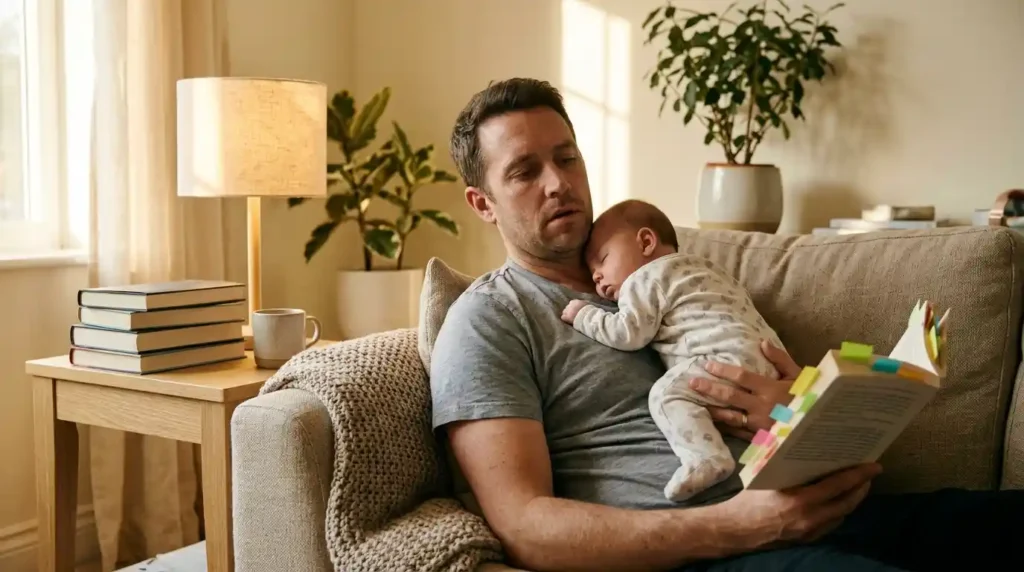
Last Sunday I stopped by Marcus’s place. One book lay open on the couch, sticky notes down the side. The other four sat on the nightstand. He’d picked one problem, Nora’s 2:40 wake-ups, and given it two weeks. She isn’t a perfect sleeper. Nobody’s is. But Marcus looked less tired, and he knew why. That’s what parenting books are good for. One problem. One idea. One try. Then another. When the problem outgrows the book, call a doctor. Nobody will judge. Not even the nightstand.
FAQs
Which books are best for first-time parents?
Start with The Happiest Baby on the Block for newborn calming. Add Precious Little Sleep for night problems. Marcus bought both at once. Don’t. Read one, then the next.
Which book is best for toddler tantrums?
The Whole-Brain Child. It has 12 strategies, and one of them is naming the feeling before you deal with the behavior. It works better with steady limits. Without them, it slides toward permissive.
Are parenting books worth reading?
Yes, if you use them for one problem at a time. They give you language, not a diagnosis. If behavior or stress makes daily life hard for weeks, talk to your doctor.
Which books help with teenagers and screen time?
Try How to Raise a Healthy Gamer for gaming and screen fights. Add Fourteen Talks by Age Fourteen for the tougher conversations. For girls, pick up Untangled. Dana read all three in a month.
