
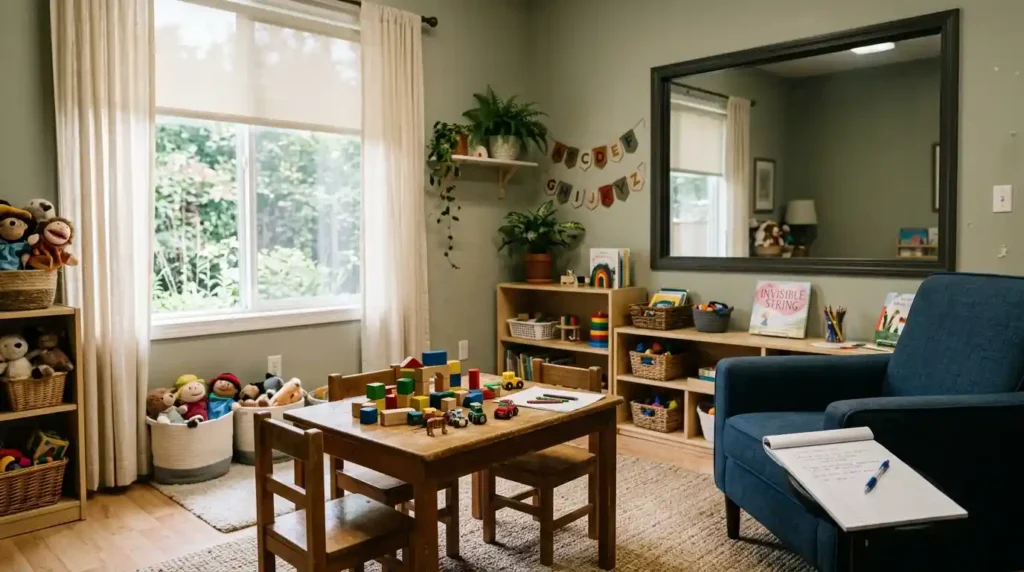
A friend of mine started parenting counseling last year after her five-year-old’s tantrums escalated to something the preschool wanted addressed directly. She assumed it would mean sitting in an office talking about her own childhood. It didn’t. Her therapist used something called Parent-Child Interaction Therapy instead, live coaching through an earpiece while she actually played with her son in the room. She said the format caught her completely off guard at first. This piece walks through what parenting counseling actually looks like across a few major approaches, based partly on research and partly on her experience working through one specific model over several months.
What Parenting Counseling Actually Involves
Most people picture one thing when they hear parenting counseling, a parent alone in a room talking to a therapist about problems at home. My friend pictured exactly that too, going in. What she got instead was her actual son, sitting on the floor building something out of blocks, while a therapist murmured instructions into her ear from behind a mirror. She said her first thought was that she’d somehow walked into the wrong appointment entirely.
The approach that fits best depends on the specific problem a family’s dealing with. Some programs work entirely through the parent, teaching skills and mindset shifts in a room without the child present. PCIT does something different, correcting the interaction itself in real time, mid-play, mid-conflict, whatever’s actually happening in the moment. My friend found the immediate feedback genuinely uncomfortable those first few sessions, a voice in her ear telling her to praise something specific right as she was already moving on to the next thing. She said it became the part she valued most by month two, once it stopped feeling like being graded.
What Happens in a Typical Parenting Counseling Session?
Depends entirely on the specific model, which is honestly the most confusing part for anyone starting out, my friend included. A traditional talk therapy session looks like exactly what you’d expect, a parent and a therapist working through strategies together. Her PCIT sessions looked nothing like that. Her son’s playtime took up nearly the entire first appointment, blocks and a toy kitchen set, while she got coached through basic phrases she hadn’t expected to need coaching on at all.
Evidence-Backed Programs Worth Knowing About
A handful of specific programs come up constantly in this research, and my friend genuinely hadn’t heard of any of them before her son’s preschool made a referral. Triple P teaches parenting skills across a broader structured curriculum, developed by Matthew Sanders, closer to a course than a one-on-one fix for a single behavior. The Incredible Years runs as a group program instead, Carolyn Webster-Stratton’s model, parents sitting together working through the same material week to week.
PCIT itself traces back to Sheila Eyberg’s original work, and it splits into two phases. Child-directed interaction comes first, just building the relationship through play. Then a parent-directed phase kicks in, introducing actual structure and limits once that foundation’s there. My friend moved through both over roughly four months. Slow going at first, she said, until somewhere around month three when her son’s tantrums started actually shortening, not vanishing, just getting noticeably briefer.
Which Parenting Counseling Program Has the Most Research Behind It?
PCIT has a genuinely substantial body of research behind it, randomized controlled trials showing real reductions in child behavior problems across multiple studies. Pooled analysis across this research has found meaningful improvements in both child conduct and parental stress, though exact numbers shift study to study, worth checking the original research directly rather than trusting any single figure as universal. My friend’s own experience loosely tracked this pattern, though obviously her one story proves nothing beyond her own living room.
How Effective Is Parenting Counseling, Really
My friend was skeptical going in, genuinely doubted it would do much beyond making her feel like she was doing something. Research across several of these programs shows real, measurable reductions in problem behaviors though, not just parents reporting they feel better about the situation. Some studies tracking families two years out found the improvements held, not just a temporary bump during active treatment weeks.
Cost is worth being honest about too. These programs aren’t free, and access isn’t equal for every family. Published research has put delivery costs somewhere in the low thousands per family in some cases, though what a family actually pays out of pocket depends heavily on insurance and whether the program runs through a school, a community clinic, or private practice. My friend’s insurance covered part of hers, and she said flatly she probably wouldn’t have finished the full program without that coverage helping absorb the cost.
Does Parenting Counseling Actually Reduce Problem Behavior in Children?
Yes, a substantial body of research across multiple evidence-based programs backs this up. Randomized trials measuring child conduct have found meaningful improvement following structured interventions like PCIT and Triple P specifically. My friend’s son didn’t stop having tantrums entirely by the end of her four months, they just got shorter and less frequent, which is roughly what the broader research would’ve predicted for her situation.
Choosing Between Individual and Group-Based Approaches
Some parenting counseling happens one-on-one, built around one specific family’s exact situation. My friend picked this route on purpose, PCIT specifically, because her son’s behavior felt urgent enough that she wanted live coaching immediately, not a waitlist for a group cohort to start.
A friend of hers went a different direction entirely, group-based, sitting in a room with six other parents working through The Incredible Years together. She told my friend the community part mattered to her more than any individual technique they covered, knowing other people were dealing with genuinely similar chaos at home. Worth thinking about if isolation is part of what’s making things feel harder than the behavior itself actually warrants.
Is One-on-One or Group Parenting Counseling Better?
Honestly it comes down to what a specific situation actually calls for, my friend’s urgent one-on-one need versus her friend’s preference for a room full of people going through the same thing. PCIT-style individual coaching fits when a child’s behavior needs real-time, tailored correction happening live. A group setting fits better when cost matters more, or when a parent genuinely needs to hear they’re not the only one dealing with this, something my friend admitted she hadn’t realized she needed until her friend described it.
Conclusion
Parenting counseling covers a genuinely wide range of approaches, live-coached interaction therapy on one end, structured group psychoeducation on the other, and picking the right one matters more than picking any single option blindly. My friend’s four months of parenting counseling weren’t a quick fix. Some sessions felt harder than others, she’d say that herself without hesitation. But the research behind programs like PCIT and Triple P is real, and her own son’s shortened tantrums by month three tracked with exactly what that evidence would predict.
Frequently Asked Questions
What is the difference between parenting counseling and family therapy?
Parenting counseling focuses specifically on parenting skills and the parent-child relationship, often through structured, evidence-based programs like PCIT or Triple P. Family therapy typically addresses broader family dynamics involving multiple relationships at once, not just the parenting piece specifically.
How long does parenting counseling usually take?
Program length varies significantly, PCIT often runs somewhere around 12 to 20 sessions depending on how quickly a family meets specific treatment goals. Group-based programs like The Incredible Years typically run a fixed number of weeks, often somewhere between 12 and 20 as well, though this varies by provider.
Is parenting counseling covered by insurance?
Coverage varies a lot depending on your specific plan and whether the provider is in-network. Many evidence-based programs are increasingly covered, at least partially, though checking directly with your insurance provider before starting is worth doing to avoid an unexpected bill.
What age range is parenting counseling designed for?
Most evidence-based programs target children roughly between ages 2 and 12, though some approaches extend into adolescence for specific behavioral concerns. PCIT specifically is designed for younger children, generally under about 7, given its play-based coaching format.

2 thoughts on “Parenting Counseling: 6 Approaches Worth Understanding Before You Start”